


Pravah the tapestry- decoding cultural stories in home decor

ABOUT PRAVAH
Pravah—meaning flow—is an intricate confluence of Phulkari embroidery and Rogan painting, centered around a richly symbolic Tree of Life. The artwork as a home decor centerpiece traces the journeys of Parsi and Punjabi cultures, echoing histories of migration along the Silk Route.
The canvas becomes a narrative tableau where memory, movement, and heritage intertwine. Vibrant Phulkari motifs inscribe lived experiences onto the fabric, while the meditative precision of Rogan painting anchors the composition.
Together, these traditional mediums merge seamlessly, creating a unified tapestry that speaks of continuity, resilience, and cultural synthesis.

DECODING PRAVAH FOR HOME DECOR
At its heart, Pravah chronicles an intimate love story—one shaped by migration, exploration, and shared belief. The artwork unfolds as a symbolic map of a couple’s journey, with the Tree of Life standing as a testament to the union of two distinct yet harmonious cultures.

Cyrus, a Parsi from Gujarat, brings the strength and grounding of Rogan painting, forming the tree’s roots and trunk—symbols of stability, mutual respect, and unwavering support. Lily, from Punjab, contributes the exuberant language of Phulkari embroidery, which blossoms across the foliage, representing growth, joy, and shared experiences.
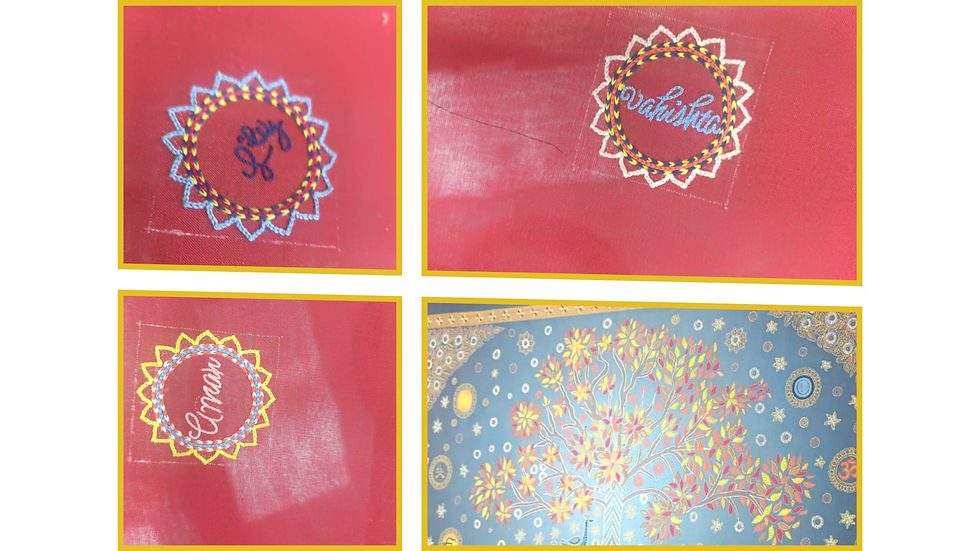
Each embroidered flower carries the name of a family member. At present, the tree honors five: Cyrus and Lily, their children Vahistha and Aman, and their beloved dog, Coco. As the family grows, so too will the tree—its branches expanding with new name-embedded blooms, celebrating life’s continual unfolding.

In the backdrop, the chants of their faith and beliefs ripple and repeat, creating an aura of tranquility and calmness that has guided them through life's challenges. Hidden within this tapestry are small, symbolic motifs: the sun and moon, representing the passage of time; auspicious peacocks, symbolizing grace and beauty; and delicate flowers, marking the milestones of their journey together. Additionally, symbolic motifs of the Ashofarohar, Ek Onkar, Om, and Shivling represent their spiritual beliefs, subtly embedded to add layers of depth and meaning.
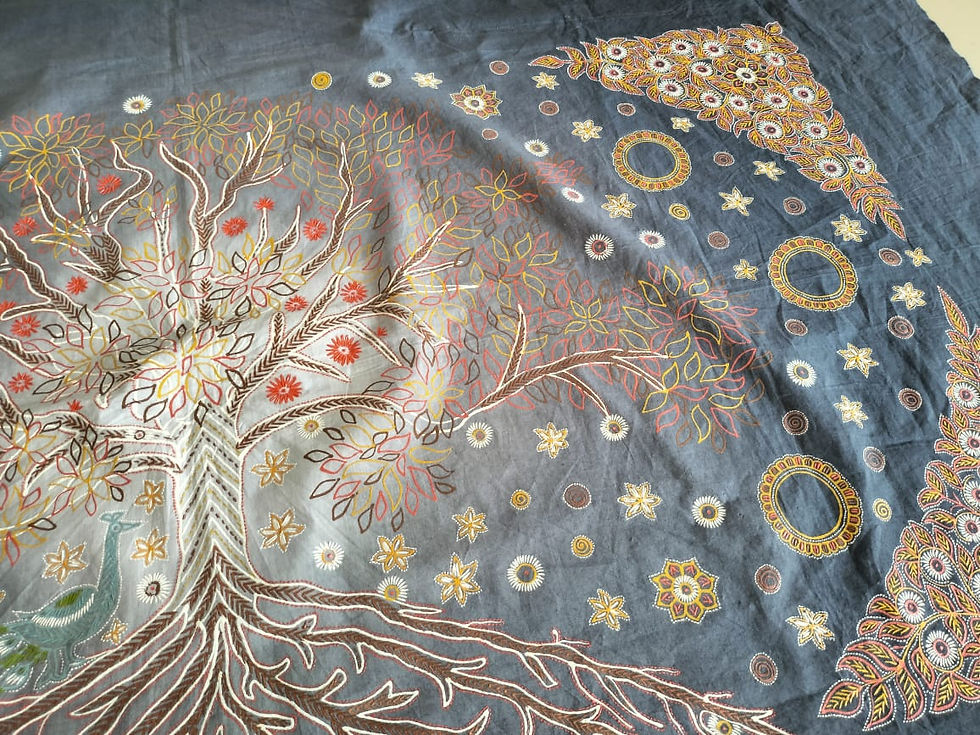
The navy blue base backdrop mirrors the couple's steadfast faith in each other, a deep and strengthening foundation that has seen them through both joyful and
trying times. The entire canvas is a romanticized tapestry of their bond, illustrating their journey of growth and healing together.

Directly opposite this main tapestry, other complementary pieces grace the wall, creating a harmonious dialogue across the space. This second pair of tapestry, continues the narrative of the Tree of Life, with its branches extending and growing towards it. The branches are adorned with embroidered symbolic flowers, each representing the core beliefs that have nurtured their journey.
The intricate embroidery and symbolic motifs of the tapestry mirror the lush
foliage of the Tree of Life, creating a visual and spiritual connection between the two pieces. This art installation not only celebrates the couple's cultural fusion and spiritual journey but also symbolizes their enduring love and the ever-growing family tree, flourishing with every new chapter of their lives.
ROGAN PAINTING IN HOME DECOR
Rogan Painting is a form of surface embellishment and practiced for over hundred years, but now by only a single family in Nirona, Kutch, Gujarat. A special paste made of castor is used in this craft. Castor seeds are hand-pounded to extract the oil and turned into a paste by boiling. Colored powder diluted in water is then mixed with this. The pastes of different colors yellow, red, blue, green, black and orange are stored in earthen-pots with water to prevent them from drying up. The kalam, an iron rod, flat at both ends, is used to paint half the design
with the support of the fingers of the left hand. It is then impressed on the other half of the cloth by pressing the two halves together.
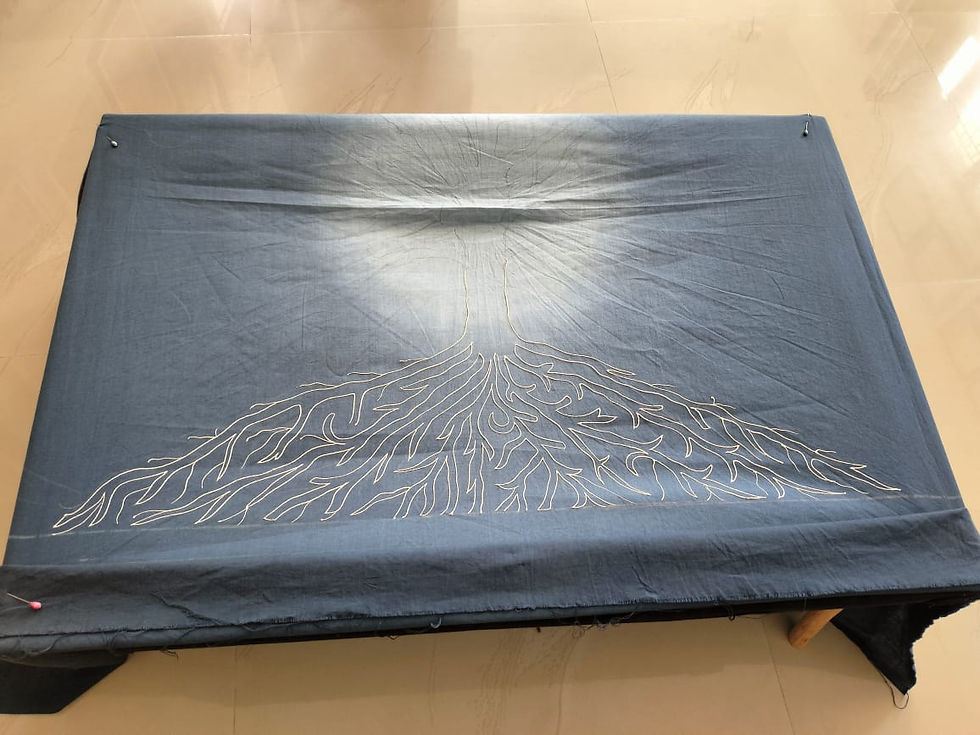
This particular artwork is made by our master artisan Rizwan Khatri, a 7th generation artisan. His work has also been showcased at the Lakme Fashion Week and a painting has also been presented by PM Modi to the British High Commissioner. Rizwan has now taken the initiative to teach this art to 15
women in his village - again a testament to his progressive approach as women were earlier barred from learning this art.
PHULKARI IN HOME DECOR
The phulkari of Punjab developed as a gifting tradition, where female relatives of a family would embroider and accrue phulkari chaddars (shawls) over the lifetime of their daughters, who would then carry them as part of the wedding dowry. A floating-yam embellishment, phulkari is a counted-thread technique, which works on a graphic principle and lends a unique and modern geometry to the cheddar's. This mid-20 century piece, a bauan-bagh phulkari (literally 52 gardens or patterns), was probably a sampler for women in the family to refer to, and such pieces are rare as the skill and restraint used to balance the composition comes after years of practice.

Tahir Ji is a distinguished first-generation master artisan in embroidery. Along with his team of karigars, he has exquisitely crafted this piece. In 1998, Tahir Ji moved to Mumbai from Lucknow and worked as a karigar for six years. His expertise and ambition led him to establish his own karkhana in 2004, initially employing over 50 artisans.
Driven by curiosity and a passion for learning, Tahir Ji expanded his skills beyond zardozi to master other traditional embroidery techniques such as lambani, phulkari, chikankari, and kantha. His innovative spirit continues to enrich
traditional Indian embroidery. However, due to COVID-19, Tahir Ji lost almost 60 percent of his artisans. Since then, EkiBeki has been helping him sustain his craft and support artisans in Mumbai.
EkiBeki and the project
Through this fusion, Pravah invites viewers to explore layered histories—where traditions travel, evolve, and take root across time and geography.
EkiBeki past projects
Coffee stories for Starbucks, Surat, in Rogan

Coffee botanicals for Starbucks, Ludhiana in Phulkari

Contact us
EkiBeki collaborate with home owners, architects and designers to integrate handcrafted murals and décor into contemporary spaces. Driving the movement that reminds Urban India that ethnic craft traditions are not niche relics, but have a living design language that belong in modern life.


Comments